
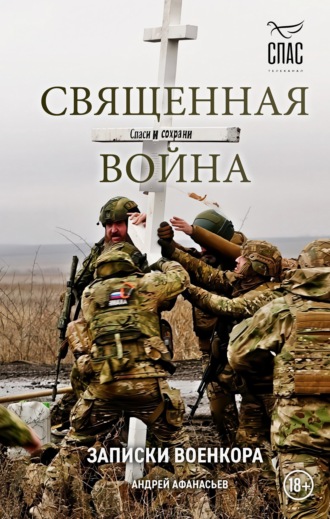
Sacred War. Notes of a War Correspondent

Andrey Afanasyev
Sacred War: Notes of a War Correspondent
© Non-Profit Organisation: Orthodox Television Foundation – Text, 2025
© A. S. Afanasyev – Text and Photos, 2025
© All-Russian Cossack Society – Cover Photo, 2025
© Eksmo publishing house, 2026
And you will hear of wars and rumors of wars. See that you are not troubled; for [a]all these things must come to pass, but the end is not yet.
From the Gospel of Matthew (Matt. 24:6)Chapter 1. A Conversation with Death
Summer of 2023
In the summer, the land of Donetsk resembles a paradise. The rich black soil and the warm, humid air drifting in from the Sea of Azov make it one of the best places not only for agriculture but for life in general. Stick a shovel handle into the ground, and it will take root and bear fruit. The Northern Black Sea region and the coast of the Sea of Azov are the cradle of the Slavic world. The kurgans scattered all around are earthen hills raised over the ancient graves of our ancestors, the Scythians. Their chieftains and kings spent their entire lives in the saddle, fighting battles. And yet beneath their feet lay such generous soil. And so, our own generation has been visited by yet another war, once again fought on this black earth, rich, dense, sticky, and thick as boiled condensed milk.

We arrived at the Ugledar front, south of Donetsk, to visit one of the units formed from Donetsk reservists, flesh formed of this very soil. The battalion had chosen to name itself in honor of “Dmitry Donskoy”; with such a heavenly patron, one can boldly undertake any feats of arms. We cover the distances between settlements quickly, accelerating across open ground and catching our breath in the windbreaks, where the engine can cool off a little as well. It is hot. In war, machines, just like men, toil at the very limit of their endurance.
We arrived, and the film crew and our military escorts tumbled out of the cab and bed of an aging pickup truck. “Hello!” “Good day!” “So how are you, how are things?” We said, using words from the local dialect. We embraced one another like family. This unit is among the most welcoming; they always receive us warmly and share their news. It seems as though we, the journalists who have come from Moscow, ought to be the ones lifting the spirits of the soldiers and officers, offering some kind of help, but it turns out to be the other way around: they share with us both their warmth and their lunches, including a hot, hearty, entirely home-style soup. In a combat zone, home-cooked food is considered good form in any unit, for every soldier misses his home.
One of the escort officers squints at us with a knowing look over his bowl of soup:
“We have a gift for you, Andrey. Journalists love exclusives, don’t they?”
“Of course, they do! What exclusive do you have?”
“We recently captured a trophy: a Kozak armored vehicle, Ukrainian-made. Fully operational. Would you like to take a ride?”
“Of course, I would!”
After lunch, we step outside the command post. Cicadas are singing, the wind plays with the steppe grasses as if with a loosened girl’s braid, and the sun shines down warmly. Truly a blessing! Then, quite nearby, I hear artillery working.
“How far is it to the line of contact from here?”
“Less than three kilometers, as the crow flies. Let’s not linger. “Birds” are flying around everywhere.”
Three kilometers. Five minutes by car, or half an hour on foot. About the same as from my place to Pashka’s, my old schoolmate who lived in the next district of Moscow. Except over there, there is no Pashka, instead there is a Pavlo, and he doesn’t wish to go for a walk, no, he wishes to “cut down the Russkies.”
Getting to those places where we’ve occasionally found ourselves is an uncommon stroke of luck for a war correspondent, and filming a captured Ukrainian vehicle, let alone riding in one, is a real feat. We race for a few minutes in the pickup truck toward a well-camouflaged motor pool, pulling off the road at full speed and into bushes beside a building. In summer, the greenery is truly effective as camouflage. If you find a dense enough grove, crawl inside like a bear and hide from prying eyes and from the lenses of enemy drones.
From its concealed spot, the captured armored vehicle rolls out. Compared to our aging Japanese pickup truck, it looks more like an enormous rig. Again, we hear an explosion nearby. The escort officer urges us to get: “Into the vehicle quickly and let’s go; we are not in the calmest of places.”
We climb into the belly of this wheeled whale. The seats are narrow and hard; the windows, doubling as firing ports, are clearly not designed for admiring the scenery. I decide to film from above using a special camera mounted at my temple, and the footage it captures is the most dynamic. The Kozak shakes mercilessly on the dirt road; I push my feet against the rungs of the hatch ladder with all my strength to keep my balance, while soldiers hold me by the ankles. Around us lay half-ruined buildings, and the traces of ongoing fighting. The footage comes out atmospheric.
Suddenly, ahead of us in our direction of travel, I notice a small column of dust, as though a little geyser had shot up from the ground. A mortar round? No, I must have imagined it; besides, there was no telltale whistle. We creep further down the road, speed low because of the bumps. Another dust column! Even closer to us, even more distinct.
“Guys, it looks like there are strikes up ahead,” I shout down through the hatch to the others.
“What makes you say that?”
“Two columns of dust appeared one after the other, right in our path. But strangely there was no whistle.”
The escorts’ faces changed. They practically yanked me down from the ladder and shouted to the driver: “Turn around fast! A mortar is working on us!”
Only later did I learn that the enemy is equipped with Polish mortars, which our soldiers consider one of the most unpleasant weapons in their arsenal. The rounds for them have no tail fin, unlike domestically produced 82-millimeter mines, so they produce no sound on approach.
In that moment I felt absolutely no fear at all. The rising dust on the road ahead of us had not stirred any powerful emotions in me, and yet in that cloud there may well have been our death, or a grievous wound. Only later, after thinking this situation over in our minds, did we understand that the enemy had been ranging in precisely on us; had we continued in the same direction, the next round would have been ours.
God is merciful.
In that moment, death was closer than it had ever been, and due to my inexperience, I had not even grasped the degree of danger. They were preparing to strike us, and I did not fully understand that, because it looked nothing like it does in feature films or even in documentary footage about war. This kind of carelessness sets in after the first few trips to a combat zone, when you begin to feel that you understand something and can “play grown-up games.” War forgives neither carelessness nor cowardice.
The grid square where we came under fire became one of the hottest stretches of the front during the so-called “counteroffensive” of the Ukrainian Armed Forces in the summer of 2023. It resulted in nothing remarkable for our enemy, yet both sides had a rather difficult time. On that same road, the trophy Kozak was struck and destroyed by enemy artillery fire. The vehicle was beyond recovery, and so the decision was made not to evacuate the hull; it was left by the roadside. The burned-out shell of the armored vehicle saved the lives of quite a few of our men: it was used as cover during the evacuation of the wounded, and the assault troops of one of the naval infantry brigades fighting in that area made particularly frequent use of it.
Reflecting on this personal episode of my encounter with mortal danger, I arrived at one of my own definitions of the spiritual condition of a person at war: it is a conversation with one’s own death. If even I, whose work does not involve a constant presence in the combat zone, had an episode like this, how many such moments must military men experience? In ordinary life, we rarely think about how we will leave this world, but out there, in a warzone, such thoughts visit you quite often. And how quickly you can cultivate a sober and calm relationship with this reality determines, to a great extent, whether you are fit to be present in a combat zone at all. The ability to find the fine line between reckless heroics on one side and ordinary human faint-heartedness on the other is perhaps the chief art one must learn. In other words, at war one must not only complete their objectives, but also contemplate.
Chapter 2. Rumors of War
Summer of 2011
“Our generation will certainly have to fight.” The phrase struck all my friends sitting around the campfire as strange. It was a warm May night in the north of the Moscow region; not quite a white night, the way St. Petersburg nights are in June, but a “gray” one. The sun sets in the west and sweeps its afterglow across the sky through the north before rising again in the east. You can walk about in the half-dark until dawn. We sit around the fire, finishing our grilled meat, drinking, and talking about everything at once. At a certain stage of such a gathering, the conversations of Russian men turn to politics, and from there to religion. So, it was this time for us as well. We, a group of seven or eight school friends, had kept up our friendships through our university years; in 2011, we all received our diplomas and found jobs. Each of us had a prestigious and promising position.
At that point, I had already been working at Russia Today for a year; I believed myself to be in the loop on all world events and shared my views with these childhood friends of mine, who had always kept a certain distance from politics. The general thrust of what I was saying could be reduced to the phrase: “They will not leave us in peace; they will certainly try to finish us off after 1991.”
I had lived with this uneasy feeling since childhood. There was a vague presentiment, not of catastrophe exactly, but of very difficult trials that would fall in full measure upon my generation: those born at the turning of the epochs, in the late 1980s and early 1990s.
Some people today would probably respond to such thoughts with something about unresolved childhood traumas or something else in that vein of amateur psychology. Perhaps it was a consequence of a childhood spent amid gang wars on the city streets, humiliating ruin, and a country coming apart at the seams. Children do not always understand what is happening with their minds, but they sense acutely the emotional state of those around them, above all, of their family. I cannot say that I feared this coming war; rather, I awaited it, for “all these things must come to pass,” as Christ says in the Gospel. And if they must, then why be afraid? One must be ready.
“Come on, don’t talk nonsense, Andrey! The world has changed; if there is a war now, it’ll be two rockets flying toward each other, cities turning to rubble, and then Mad Max for the survivors.” That was precisely the picture of the world my friends offered up, an extremely common one. I recall it without mockery or judgment; I confess I thought the same way myself. How could one think otherwise? Clearly, if there was going to be a war, it would be between us and the West, or rather the United States; who else would be our adversary? If both sides possess nuclear weapons, and the two largest arsenals in the world at that, then that is how it would all end. Someone “at the very top,” or perhaps in our general staff or the American one, would lose his nerve, his hand would falter, and then it would unfold like a disaster film. From silos and submarines, enormous rockets would rise into the sky, at first at an ominously slow pace, then gathering speed with terrifying swiftness, then explosions, millions of deaths in a single second, and afterward one of the scenarios from those same Hollywood films, ranging from The Matrix to Reign of Fire. The thinking of our generation had been shaped almost entirely by Western culture, and our imagination could not reach beyond their scripts. No one was yet talking much about hybrid wars, or about the “rebellion-war” described back in the middle of the twentieth century; all the military terms that are now on every ordinary person’s lips were at that time the preserve of a narrow circle of specialists.
Конец ознакомительного фрагмента.
Текст предоставлен ООО «Литрес».
Прочитайте эту книгу целиком, купив полную легальную версию на Литрес.
Безопасно оплатить книгу можно банковской картой Visa, MasterCard, Maestro, со счета мобильного телефона, с платежного терминала, в салоне МТС или Связной, через PayPal, WebMoney, Яндекс.Деньги, QIWI Кошелек, бонусными картами или другим удобным Вам способом.
Приобретайте полный текст книги у нашего партнера: