


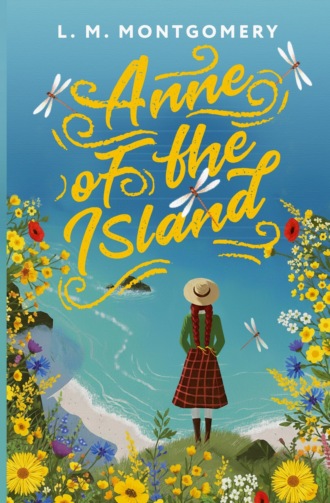
Anne of the Island / Аня с острова Принца Эдуарда
Gilbert and Anne, happily unconscious that their future was thus being settled by Mrs. Rachel, were sauntering through the shadows of the Haunted Wood. Beyond, the harvest hills were basking in an amber sunset radiance, under a pale, aerial sky of rose and blue. The distant spruce groves were burnished bronze, and their long shadows barred the upland meadows. But around them a little wind sang among the fir tassels, and in it there was the note of autumn.
“This wood really is haunted now – by old memories,” said Anne, stooping to gather a spray of ferns, bleached to waxen whiteness by frost. “It seems to me that the little girls Diana and I used to be play here still, and sit by the Dryad's Bubble in the twilights, trysting with the ghosts. Do you know, I can never go up this path in the dusk without feeling a bit of the old fright and shiver? There was one especially horrifying phantom which we created – the ghost of the murdered child that crept up behind you and laid cold fingers on yours. I confess that, to this day, I cannot help fancying its little, furtive footsteps behind me when I come here after nightfall. I'm not afraid of the White Lady or the headless man or the skeletons, but I wish I had never imagined that baby's ghost into existence. How angry Marilla and Mrs. Barry were over that affair,” concluded Anne, with reminiscent laughter.
The woods around the head of the marsh were full of purple vistas, threaded with gossamers. Past a dour plantation of gnarled spruces and a maple-fringed, sun-warm valley they found the “something” Gilbert was looking for.
“Ah, here it is,” he said with satisfaction.
“An apple tree – and away back here!” exclaimed Anne delightedly.
“Yes, a veritable apple-bearing apple tree, too, here in the very midst of pines and beeches, a mile away from any orchard. I was here one day last spring and found it, all white with blossom. So I resolved I'd come again in the fall and see if it had been apples. See, it's loaded. They look good, too – tawny as russets but with a dusky red cheek. Most wild seedlings are green and uninviting.”
“I suppose it sprang years ago from some chance-sown seed,” said Anne dreamily. “And how it has grown and flourished and held its own here all alone among aliens, the brave determined thing!”
“Here's a fallen tree with a cushion of moss. Sit down, Anne – it will serve for a woodland throne. I'll climb for some apples. They all grow high – the tree had to reach up to the sunlight.”
The apples proved to be delicious. Under the tawny skin was a white, white flesh, faintly veined with red; and, besides their own proper apple taste, they had a certain wild, delightful tang no orchard-grown apple ever possessed.
“The fatal apple of Eden couldn't have had a rarer flavor,” commented Anne. “But it's time we were going home. See, it was twilight three minutes ago and now it's moonlight. What a pity we couldn't have caught the moment of transformation. But such moments never are caught, I suppose.”
“Let's go back around the marsh and home by way of Lover's Lane. Do you feel as disgruntled now as when you started out, Anne?”
“Not I. Those apples have been as manna to a hungry soul. I feel that I shall love Redmond and have a splendid four years there.”
“And after those four years – what?”
“Oh, there's another bend in the road at their end,” answered Anne lightly. “I've no idea what may be around it – I don't want to have. It's nicer not to know.”
Lover's Lane was a dear place that night, still and mysteriously dim in the pale radiance of the moonlight. They loitered through it in a pleasant chummy silence, neither caring to talk.
“If Gilbert were always as he has been this evening how nice and simple everything would be,” reflected Anne.
Gilbert was looking at Anne, as she walked along. In her light dress, with her slender delicacy, she made him think of a white iris.
“I wonder if I can ever make her care for me,” he thought, with a pang of self-distrust.
Chapter III. Greeting and Farewell
Charlie Sloane, Gilbert Blythe and Anne Shirley left Avonlea the following Monday morning. Anne had hoped for a fine day. Diana was to drive her to the station and they wanted this, their last drive together for some time, to be a pleasant one. But when Anne went to bed Sunday night the east wind was moaning around Green Gables with an ominous prophecy which was fulfilled in the morning. Anne awoke to find raindrops pattering against her window and shadowing the pond's gray surface with widening rings; hills and sea were hidden in mist, and the whole world seemed dim and dreary. Anne dressed in the cheerless gray dawn, for an early start was necessary to catch the boat train; she struggled against the tears that would well up in her eyes in spite of herself. She was leaving the home that was so dear to her, and something told her that she was leaving it forever, save as a holiday refuge. Things would never be the same again; coming back for vacations would not be living there. And oh, how dear and beloved everything was – that little white porch room, sacred to the dreams of girlhood, the old Snow Queen at the window, the brook in the hollow, the Dryad's Bubble, the Haunted Woods, and Lover's Lane – all the thousand and one dear spots where memories of the old years bided. Could she ever be really happy anywhere else?
Breakfast at Green Gables that morning was a rather doleful meal. Davy, for the first time in his life probably, could not eat, but blubbered shamelessly over his porridge. Nobody else seemed to have much appetite, save Dora, who tucked away her rations comfortably. Dora, like the immortal and most prudent Charlotte, who “went on cutting bread and butter” when her frenzied lover's body had been carried past on a shutter, was one of those fortunate creatures who are seldom disturbed by anything. Even at eight it took a great deal to ruffle Dora's placidity. She was sorry Anne was going away, of course, but was that any reason why she should fail to appreciate a poached egg on toast? Not at all. And, seeing that Davy could not eat his, Dora ate it for him.
Promptly on time Diana appeared with horse and buggy, her rosy face glowing above her raincoat. The good-byes had to be said then somehow. Mrs. Lynde came in from her quarters to give Anne a hearty embrace and warn her to be careful of her health, whatever she did. Marilla, brusque and tearless, pecked Anne's cheek and said she supposed they'd hear from her when she got settled. A casual observer might have concluded that Anne's going mattered very little to her – unless said observer had happened to get a good look in her eyes. Dora kissed Anne primly and squeezed out two decorous little tears; but Davy, who had been crying on the back porch step ever since they rose from the table, refused to say good-bye at all. When he saw Anne coming towards him he sprang to his feet, bolted up the back stairs, and hid in a clothes closet, out of which he would not come. His muffled howls were the last sounds Anne heard as she left Green Gables.
It rained heavily all the way to Bright River, to which station they had to go, since the branch line train from Carmody did not connect with the boat train. Charlie and Gilbert were on the station platform when they reached it, and the train was whistling. Anne had just time to get her ticket and trunk check, say a hurried farewell to Diana, and hasten on board. She wished she were going back with Diana to Avonlea; she knew she was going to die of homesickness. And oh, if only that dismal rain would stop pouring down as if the whole world were weeping over summer vanished and joys departed! Even Gilbert's presence brought her no comfort, for Charlie Sloane was there, too, and Sloanishness could be tolerated only in fine weather. It was absolutely insufferable in rain.
But when the boat steamed out of Charlottetown harbor things took a turn for the better. The rain ceased and the sun began to burst out goldenly now and again between the rents in the clouds, burnishing the gray seas with copper-hued radiance, and lighting up the mists that curtained the Island's red shores with gleams of gold foretokening a fine day after all. Besides, Charlie Sloane promptly became so seasick that he had to go below, and Anne and Gilbert were left alone on deck.
“I am very glad that all the Sloanes get seasick as soon as they go on water,” thought Anne mercilessly. “I am sure I couldn't take my farewell look at the 'ould sod' with Charlie standing there pretending to look sentimentally at it, too.”
“Well, we're off,” remarked Gilbert unsentimentally.
“Yes, I feel like Byron's 'Childe Harold'– only it isn't really my 'native shore' that I'm watching,” said Anne, winking her gray eyes vigorously. “Nova Scotia is that, I suppose. But one's native shore is the land one loves the best, and that's good old P.E.I. for me. I can't believe I didn't always live here. Those eleven years before I came seem like a bad dream. It's seven years since I crossed on this boat – the evening Mrs. Spencer brought me over from Hopetown. I can see myself, in that dreadful old wincey dress and faded sailor hat, exploring decks and cabins with enraptured curiosity. It was a fine evening; and how those red Island shores did gleam in the sunshine. Now I'm crossing the strait again. Oh, Gilbert, I do hope I'll like Redmond and Kingsport, but I'm sure I won't!”
“Where's all your philosophy gone, Anne?”
“It's all submerged under a great, swamping wave of loneliness and homesickness. I've longed for three years to go to Redmond – and now I'm going – and I wish I weren't! Never mind! I shall be cheerful and philosophical again after I have just one good cry. I must have that, 'as a went'– and I'll have to wait until I get into my boardinghouse bed tonight, wherever it may be, before I can have it. Then Anne will be herself again. I wonder if Davy has come out of the closet yet.”
It was nine that night when their train reached Kingsport, and they found themselves in the blue-white glare of the crowded station. Anne felt horribly bewildered, but a moment later she was seized by Priscilla Grant, who had come to Kingsport on Saturday.
“Here you are, beloved! And I suppose you're as tired as I was when I got here Saturday night.”
“Tired! Priscilla, don't talk of it. I'm tired, and green, and provincial, and only about ten years old. For pity's sake take your poor, broken-down chum to some place where she can hear herself think.”
“I'll take you right up to our boardinghouse. I've a cab ready outside.”
“It's such a blessing you're here, Prissy. If you weren't I think I should just sit down on my suitcase, here and now, and weep bitter tears. What a comfort one familiar face is in a howling wilderness of strangers!”
“Is that Gilbert Blythe over there, Anne? How he has grown up this past year! He was only a schoolboy when I taught in Carmody. And of course that's Charlie Sloane. He hasn't changed – couldn't! He looked just like that when he was born, and he'll look like that when he's eighty. This way, dear. We'll be home in twenty minutes.”
“Home!” groaned Anne. “You mean we'll be in some horrible boardinghouse, in a still more horrible hall bedroom, looking out on a dingy back yard.”
“It isn't a horrible boardinghouse, Anne-girl. Here's our cab. Hop in – the driver will get your trunk. Oh, yes, the boardinghouse – it's really a very nice place of its kind, as you'll admit tomorrow morning when a good night's sleep has turned your blues rosy pink. It's a big, old-fashioned, gray stone house on St. John Street, just a nice little constitutional from Redmond. It used to be the 'residence' of great folk, but fashion has deserted St. John Street and its houses only dream now of better days. They're so big that people living in them have to take boarders just to fill up. At least, that is the reason our landladies are very anxious to impress on us. They're delicious, Anne – our landladies, I mean.”
“How many are there?”
“Two. Miss Hannah Harvey and Miss Ada Harvey. They were born twins about fifty years ago.”
“I can't get away from twins, it seems,” smiled Anne. “Wherever I go they confront me.”
“Oh, they're not twins now, dear. After they reached the age of thirty they never were twins again. Miss Hannah has grown old, not too gracefully, and Miss Ada has stayed thirty, less gracefully still. I don't know whether Miss Hannah can smile or not; I've never caught her at it so far, but Miss Ada smiles all the time and that's worse. However, they're nice, kind souls, and they take two boarders every year because Miss Hannah's economical soul cannot bear to 'waste room space'– not because they need to or have to, as Miss Ada has told me seven times since Saturday night. As for our rooms, I admit they are hall bedrooms, and mine does look out on the back yard. Your room is a front one and looks out on Old St. John's graveyard, which is just across the street.”
“That sounds gruesome,” shivered Anne. “I think I'd rather have the back yard view.”
“Oh, no, you wouldn't. Wait and see. Old St. John's is a darling place. It's been a graveyard so long that it's ceased to be one and has become one of the sights of Kingsport. I was all through it yesterday for a pleasure exertion. There's a big stone wall and a row of enormous trees all around it, and rows of trees all through it, and the queerest old tombstones, with the queerest and quaintest inscriptions. You'll go there to study, Anne, see if you don't. Of course, nobody is ever buried there now. But a few years ago they put up a beautiful monument to the memory of Nova Scotian soldiers who fell in the Crimean War. It is just opposite the entrance gates and there's 'scope for imagination' in it, as you used to say. Here's your trunk at last – and the boys coming to say good night. Must I really shake hands with Charlie Sloane, Anne? His hands are always so cold and fishy-feeling. We must ask them to call occasionally. Miss Hannah gravely told me we could have 'young gentlemen callers' two evenings in the week, if they went away at a reasonable hour; and Miss Ada asked me, smiling, please to be sure they didn't sit on her beautiful cushions. I promised to see to it; but goodness knows where else they can sit, unless they sit on the floor, for there are cushions on everything. Miss Ada even has an elaborate Battenburg one on top of the piano.”
Anne was laughing by this time. Priscilla's gay chatter had the intended effect of cheering her up; homesickness vanished for the time being, and did not even return in full force when she finally found herself alone in her little bedroom. She went to her window and looked out. The street below was dim and quiet. Across it the moon was shining above the trees in Old St. John's, just behind the great dark head of the lion on the monument. Anne wondered if it could have been only that morning that she had left Green Gables. She had the sense of a long passage of time which one day of change and travel gives.
“I suppose that very moon is looking down on Green Gables now,” she mused. “But I won't think about it – that way homesickness lies. I'm not even going to have my good cry. I'll put that off to a more convenient season, and just now I'll go calmly and sensibly to bed and to sleep.”
Chapter IV. April's Lady
Kingsport is a quaint old town, hearking back to early Colonial days, and wrapped in its ancient atmosphere, as some fine old dame in garments fashioned like those of her youth. Here and there it sprouts out into modernity, but at heart it is still unspoiled; it is full of curious relics, and haloed by the romance of many legends of the past. Once it was a mere frontier station on the fringe of the wilderness, and those were the days when Indians kept life from being monotonous to the settlers. Then it grew to be a bone of contention between the British and the French, being occupied now by the one and now by the other, emerging from each occupation with some fresh scar of battling nations branded on it.
It has in its park a martello tower, autographed all over by tourists, a dismantled old French fort on the hills beyond the town, and several antiquated cannon in its public squares. It has other historic spots also, which may be hunted out by the curious, and none is more quaint and delightful than Old St. John's Cemetery at the very core of the town, with streets of quiet, old-time houses on two sides, and busy, bustling, modern thoroughfares on the others. Every citizen of Kingsport feels a thrill of possessive pride in Old St. John's, for, if he be of any pretensions at all, he has an ancestor buried there, with a queer, crooked slab at his head, or else sprawling protectively over the grave, on which all the main facts of his history are recorded. For the most part no great art or skill was lavished on those old tombstones. The larger number are of roughly chiselled brown or gray native stone, and only in a few cases is there any attempt at ornamentation. Some are adorned with skull and cross-bones, and this grizzly decoration is frequently coupled with a cherub's head. Many are prostrate and in ruins. Into almost all Time's tooth has been gnawing, until some inscriptions have been completely effaced, and others can only be deciphered with difficulty. The graveyard is very full and very bowery, for it is surrounded and intersected by rows of elms and willows, beneath whose shade the sleepers must lie very dreamlessly, forever crooned to by the winds and leaves over them, and quite undisturbed by the clamor of traffic just beyond.
Anne took the first of many rambles in Old St. John's the next afternoon. She and Priscilla had gone to Redmond in the forenoon and registered as students, after which there was nothing more to do that day. The girls gladly made their escape, for it was not exhilarating to be surrounded by crowds of strangers, most of whom had a rather alien appearance, as if not quite sure where they belonged.
The “freshettes” stood about in detached groups of two or three, looking askance at each other; the “freshies,” wiser in their day and generation, had banded themselves together on the big staircase of the entrance hall, where they were shouting out glees with all the vigor of youthful lungs, as a species of defiance to their traditional enemies, the Sophomores, a few of whom were prowling loftily about, looking properly disdainful of the “unlicked cubs” on the stairs. Gilbert and Charlie were nowhere to be seen.
Конец ознакомительного фрагмента.
Текст предоставлен ООО «Литрес».
Прочитайте эту книгу целиком, купив полную легальную версию на Литрес.
Безопасно оплатить книгу можно банковской картой Visa, MasterCard, Maestro, со счета мобильного телефона, с платежного терминала, в салоне МТС или Связной, через PayPal, WebMoney, Яндекс.Деньги, QIWI Кошелек, бонусными картами или другим удобным Вам способом.
Приобретайте полный текст книги у нашего партнера: