
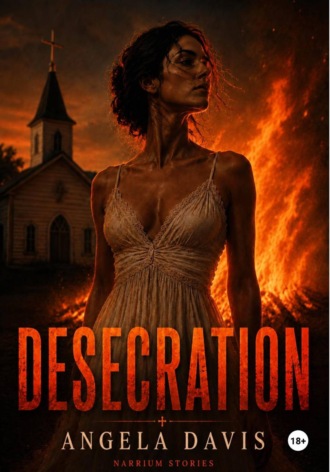
DESECRATION

Angela Davis, Narrium Stories
DESECRATION
Chapter 1. The Fire
I can see their faces in the flames. I know every one of them.
The sheriff stands to my right. Hands in his pockets – he always hid his hands when he didn't know what to do with them. I remember those hands. I remember the wedding ring he never took off. It used to catch my skin, and he never noticed, but I did, and I said nothing – because silence was the only thing I gave him for free. Everything else cost him something. He just never knew what.
Pastor Elrod keeps to the edge of the crowd. Of course. Praying aloud to drown out what he's thinking in the quiet. He's staring at the ground now. He has a small birthmark on his right temple that I know better than his own wife does. His wife is home tonight. She's the only person in this town who didn't come – and that's not virtue. That's just not knowing.
Susan March stands at the far left in a white blouse with pearl buttons. She wears it only on Sundays. Today is Saturday. Which means she dressed for this. For Susan, tonight is a celebration – the most honest one she's had in two years, because two years she's known that her husband doesn't lock the shop at lunch to eat. She looks at me with an expression she mistakes for righteousness. I read it differently: relief. Finally there's someone to blame who burns instead of her.
Harry March stands three steps from his wife, studying the toes of his shoes. He always took his glasses off before he kissed me – as if he wanted to see me slightly blurred, slightly less real. Afterward he'd start talking immediately. Weather. Gas prices. Anything. He couldn't stand the silence that was left. He can't stand it now either. He just keeps quiet.
Young Tyler holds the torch in both hands the way people hold weapons when they've never held a weapon before. He's not yet twenty-five. He was never with me. He wanted to be – I saw it every time he took the window seat at the diner and ordered coffee he didn't drink, watching me move between tables. The ones who wanted and didn't get are always angrier than the ones who got and lost. That's the first thing you learn in a town like this.
The heat at the end of June is particular here. The earth gives back everything it's held all day, right into your face – rising from the ground up, pushing out from inside itself. The air between me and them shimmers. It could be beautiful: heat haze over red clay, the white church behind their backs, a sky that hasn't decided whether to darken yet. It could be, if I weren't burning.
The fire behind me doesn't behave the way I expected.
I expected it all at once – one blow. Instead it moves slowly, deliberately, as if it owns the place. First the fabric – the dress caught at the hem, and I felt heat at my ankles before I saw the flame. Then skin. Silk smells like burnt sugar when it burns – I didn't know that before. Now I do. Then the pain stops being pain and becomes something else: not a language but a voice, the body speaking when ordinary words run out. I stand still. Not because I can't move. Because I won't give them that.
I don't scream.
It surprises them – I can see it in their faces. They were waiting for a scream. They always waited for me to give them what they needed.
Tyler tightens his grip on the torch – pointless now, it's already done its work. Someone in the back rows steps away as the flames rise higher. The sheriff has pulled his hands out of his pockets and doesn't know what to do with them – he holds them slightly forward, slightly bent, like a man waiting for someone to hand him something. Susan presses her lips together: she didn't scream, so the scene isn't what it was supposed to be. Pastor Elrod looks up – for a fraction of a second our eyes meet, and he's the first to look away. Of course.
The smoke rises and drifts slightly sideways. Somewhere in that smoke is what used to be my dress. White. I wore it three weeks ago when Cole and I went to the judge and he signed with his journalist's hand – quick, slanted left – and I signed slowly, as if I needed to be certain my hand wouldn't shake.
It didn't.
I don't look for Cole. I know he isn't here. They came for him first.
I think about the first time he asked permission to photograph me. He just asked – not assuming, not implying, not making it sound like something too small to refuse. In this town men didn't ask permission. They took, called it desire, and left, and the feeling they left behind was of being used as a pretext for something they were ashamed to admit to themselves.
Cole asked.
That was what opened me. The way a lock opens when you find the right key – not because it's been forced, but because it was always yours.
They called me shameless. As if shame was something they were supposed to give me and I had refused to take it. As if my freedom was an insult to their dignity.
I was their secret. Each of them thought he was the only one. The sheriff didn't know about the pastor. The pastor didn't know about Harry. Harry didn't know about anyone. They lived side by side, shook hands after Sunday service – and each one carried his private, carefully guarded knowledge of me the way you carry something stolen: tightly, and in silence.
Until one of them saw Cole.
The mistake wasn't in what I gave. The mistake was that they decided it was forever. That it was a right. That I was land – land that could be planted and would keep giving until it ran dry.
I didn't run dry. For the first time I claimed myself – without their consent, without their knowledge, without looking back at what any of them thought about it. That's what they couldn't bear. Not that I'd been with others. That I'd chosen one – myself, without asking.
That's the desecration. Not the past. The choice.
The fire has reached my shoulders. My hair begins to smell – I notice it before I feel the heat. A strange smell: bitter, almost familiar. Somewhere in the crowd a child is crying – brought here to remember. To know what happens. That child will grow up and call tonight righteousness. Or will grow up and not be able to sleep. One or the other.
I look at them one by one. I take my time.
The sheriff has hidden his hands again. Tyler finally turns away – not from shame, but from fear that I'll hold my gaze on him too long. Susan presses a handkerchief to her lips: the gesture that's expected, and she has always done what's expected. The pastor looks back at the ground and moves his lips without sound.
They came here to kill me.
But each of them will carry this evening home. Will lie down – beside a wife or alone – and this will be the last thing before sleep. Not the flames.
My face in the fire.
I didn't scream. That's what they'll never forget.
Chapter 2. The Wedding
Cole was fastening the buttons at my back, and I was watching his hands in the mirror.
Twenty-three buttons. He counted them aloud – quietly, almost to himself – and paused at each one a beat longer than necessary. As if he wanted to be sure every one was in place. As if it mattered.
To him it did.
– Twenty-three, – he said, catching my eyes in the mirror. – That's a lot.
– Makes it interesting to undo.
He smiled – not the smile you give a good joke, but the one you give when the person beside you turns out to be exactly who you hoped they'd be. I memorized that smile. I knew I would.
He adjusted the last button at the base of my neck, touched the skin there – one finger, in passing – and stepped back.
– Ready?
I looked at the woman in white in the mirror. She looked back with an expression I might have called calm, if I hadn't known it was something else. Not calm. The resolve of someone who has chosen and no longer doubts.
– Yes.
The church was full.
That didn't surprise me. In a small town a wedding is something you can't miss. Especially a wedding like this. Especially a bride like this. They all came – in their best dresses, in ties, with children, hair done, perfumed. They filled the pews from the first row to the last, and as I walked down the aisle on Cole's arm I saw their faces on either side of me, like two riverbanks I had no choice but to move between.
The sheriff – third row, left. Hands on his knees. He gave me a short nod, almost official. I nodded back and thought about his wedding ring, the one he never took off, not even then. It was here now, on his finger, in the third row, at my wedding.
Susan March – fourth row, a pink dress I'd never seen on her before. A wide, warm smile. I smiled back.
Harry March didn't look up at all.
Pastor Elrod stood at the altar.
He was in his white vestments, solemn and straight, and his face wore exactly the expression a pastor's face should wear at a wedding: open, serene, glad in the Lord. He watched us as we walked to the altar – Cole and me – and there was nothing in his gaze that betrayed anything other than pastoral goodwill.
I knew the birthmark on his right temple.
I knew how he said God's name when he was thinking of something else.
I stopped beside Cole before the altar, and Elrod began the service. His voice was beautiful – deep, even, well-trained. He spoke the right words in the right order: fidelity, covenant, a mystery above all human agreement. He held the Bible slightly higher than usual – high enough to see me over the top of it, not so high that it was obvious he was looking.
I noticed.
Cole held my hand. His palm was dry and warm. He didn't squeeze – just held, the way you hold something you're certain of. I watched Elrod and listened to words about the sanctity of marriage from a man who had asked me for secrecy – and at that exact moment his voice broke.
Barely. Half a beat. Almost nothing.
But I heard it.
He was saying the words about God joining two people forever – and on the word forever his voice shifted pitch for just a moment. Didn't crack. Just – wavered. The way glass shakes before it splits. He caught himself immediately, continued, and no one in the room likely noticed.
Cole didn't notice.
I did.
Elrod looked up at me – for a second – then back down. I read that movement. He was searching for something in my face: judgment, triumph, anger. Anything that might let him feel like the victim rather than the one at fault. I gave him nothing. I looked at him evenly, and he looked back at the ground.
– If anyone here knows of a reason why this marriage should not take place, – he said, – let them speak now.
Silence.
Full, thick, almost ringing. The kind that only lives in churches and in moments people remember for a long time after. I stood and heard the June heat pressing against the stained glass from outside. Somewhere in the back rows someone shifted on a pew. Someone closer changed position, and the wood creaked.
The sheriff – no. Too careful, too much to lose. Harry – no, he couldn't stand being seen. Tyler might have – if he'd already worked up the nerve by then. Pastor Elrod wouldn't stand against himself.
Nobody stood.
They weren't ready to act publicly yet. That came later. First there was silence – quiet, accumulating, the way water builds behind a dam.
Elrod held the pause exactly as long as required, then continued.
When Cole slipped the ring onto my finger – simple, thin, no stone, the one I'd chosen myself – I felt Susan March shift slightly on her pew. Just barely. The way someone shifts when they've become uncomfortable but don't want anyone to see.
On the lawn there was champagne, white tablecloths, lilies in vases, and June sun burning bare shoulders. The town congratulated us.
The sheriff was first to approach Cole. He extended his hand – wide, easy, with a smile. Cole shook it. They exchanged something brief – I couldn't hear the words, only the register: friendly, about nothing. The sheriff clapped Cole on the shoulder. Cole laughed. The sheriff turned to me – smile, nod, everything correct – and moved on.
I watched his back and thought: so this is what it looks like from the outside. Good neighbors. A kind town.
Susan came to me while I was standing at the table. She took both my hands in hers – firmly, the way you take someone's hands when you have something important to say.
– Magda. You look beautiful today.
– Thank you, Susan.
– Are you happy? – She was looking straight at me, and behind the question was something else – not yet hostility, but something close to a test.
– Yes, – I said. – I'm happy.
She squeezed my hands once more and stepped away. The smile held on her face for about three more seconds after she turned.
Harry March walked past with a glass. He didn't congratulate me. I caught his eye for a fraction of a second – he looked away immediately, out of habit, the way people look away in the dark when they don't want to be seen.
Tyler never came over. But at some point I felt his gaze and turned. He was looking at my ring. Not at me – at the ring. With an expression I couldn't name right away. Then I found it: the face of a man who's just realized he lost a game he thought he wasn't playing.
Pastor Elrod stood at the edge of the lawn without his vestments, in an ordinary shirt with an open collar. Talking to someone nearby – seriously, in a low voice. His ordinariness after the altar was almost indecent. An hour ago he'd been speaking of eternity. Now he was drinking champagne and talking about the weather or the parish, and nothing about him gave away a man whose voice had just wavered on the word forever.
Cole found me at the far edge of the lawn, where the shadow of an old oak gave a little relief from the heat.
– You're thinking about something, – he said.
– You.
– That's a different face. Not the one you make when you're thinking about me.
– You're a photographer. You're not supposed to read faces.
– Too late. Already learned.
I looked at him. At the man who had come to photograph dying towns and hadn't left. Who had seen good neighbors with champagne and wide smiles today. Who had shaken the sheriff's hand and felt nothing wrong in it.
– Good town, – he said. – Everyone came.
– Yes, – I said. – Everyone came.
He lifted my hand and kissed my wrist – quickly, like placing a period.
The white lilies on the tables were dying in the heat.
I watched them and thought: until today they had lived with the idea that I was common property. That I was air they could breathe quietly, each one alone, none of them knowing about the others. That it would always be that way.
Today that air ran out.
Today it was official: I had claimed myself without their input, without their permission, without considering what any of them believed was their right. And the ring on my finger – plain, thin, no stone – wasn't an ornament. It was a document. A certificate that the door was closed.
They were still smiling. Still drinking to us. Still saying many happy years.
Конец ознакомительного фрагмента.
Текст предоставлен ООО «Литрес».
Прочитайте эту книгу целиком, купив полную легальную версию на Литрес.
Безопасно оплатить книгу можно банковской картой Visa, MasterCard, Maestro, со счета мобильного телефона, с платежного терминала, в салоне МТС или Связной, через PayPal, WebMoney, Яндекс.Деньги, QIWI Кошелек, бонусными картами или другим удобным Вам способом.
Приобретайте полный текст книги у нашего партнера: