
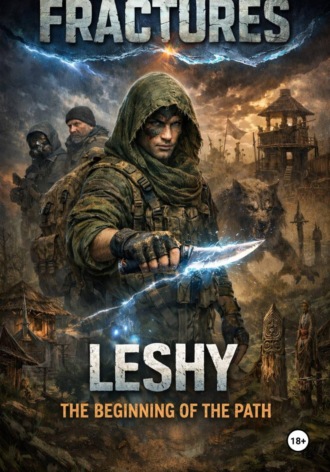
Leshy. The Beginning of the Path
"They found a spatial bubble. I was a mercenary, I accompanied them on expeditions — we had our own zones too. Similar to yours, but not quite. There were no stalkers. There were those who lived inside permanently — we called them the Darks. They almost never made contact, often fought us. They considered the zone their home and us — uninvited guests."
He paused slightly.
"Basically, our brains overloaded the bubble with some kind of pulse installations. It collapsed. Me and a couple of others got pulled into a spatial hole. A moment — and I'm lying in unfamiliar terrain. Haven't found my people. Six months, no trace of them — alive or dead."
Borland nodded — not commenting, just indicating: he was listening.
"While looking for information about them, I came across strange mentions. About you. About your adoptive fathers. That you weren't the same kind of stalkers as all the rest, kept to yourselves, few witnesses to your oddities, but they existed. As soon as I found out you were going to lead our group — I didn't take my eyes off you. Watched and absorbed everything." A small pause. "You don't have to be afraid of me."
He looked at Borland — directly, without excess.
"Let's be partners for a while. You clearly have more experience. We'll find the locals, sort out the situation. Then we'll figure out where to go from there."
He fell silent. Then added — more quietly, without the composure that had been in his voice all the rest of the time:
"I'd like to return to my world. To my family."
And that was it. No more words.
Borland looked at him. From Vint the whole time it had been unusual to hear this many words in a row — and especially these ones. The last phrase came not as a complaint and not as a request. Simply — a fact. Quiet, heavy, one of those that require no answer.
Borland knew that feeling.
He looked at the unfamiliar horizon — hills, unfamiliar shrubs, a foreign sky — and thought that he too had a world he wanted to return to. Only he didn't know how it looked now. Or whether it still existed.
"Accepted," he said at last. "Partners."
He stood, shouldered his pack.
"We need to find landmarks. Understand where we've ended up, whether there are people here, how active the zone is." He took out the detector, looked at the readings. "The background is weak, but it's there. Meaning anomalies are somewhere. Meaning there are also those who live with them."
Vint stood alongside — silently, without questions. Again composed, again that professional gaze reading the space like text.
"That way," said Borland, nodding northeast, where the hills lowered slightly. "Lowlands always make it easier to find water. Where there's water — there are people."
They walked.
* * *
The new world accepted them quietly. Without threat, without greeting — it simply opened around them, unfamiliar and calm, the way it is at the start of a journey when you don't yet know what's ahead.
Borland walked and thought about Krot — had he made it, had he brought the group through. About where Khimik and Prigorshnya were right now and whether they knew he was already in another world. About the tear in the center of the anomalous field, which seemed to have been waiting for him.
Not all doors lead where you wish to go.
The elder had said something similar. Just in different words.
Vint walked alongside — quiet, slightly behind and to the right, his usual distance. But now it read differently. Not surveillance. Cover.
Ahead there were many questions and few answers.
Borland smiled. In the zone it was always that way.
Chapter 10. Frankenstein
They walked the valley between the hills all day — steady, without hurrying, without incident.
That itself was strange.
Borland was used to a new world greeting you immediately — with an anomaly, a mutant, at least the smell of a zone that you couldn't confuse with anything else. Here — nothing. Just the valley, grass, hills on either side, and a sky that was slightly the wrong shade — not grey and not blue, but somewhere between, as if it couldn't quite decide.
"Strange, all of this," said Borland when the sun began to lean toward the horizon. "Fractures usually lead into another zone. But here it's as if there's no zone at all."
Vint shrugged. That conversation on the stumps seemed to have taken his word supply for several days ahead — and something else too, beyond words. Something from memory had risen and was now lying inside, quiet and heavy.
Borland didn't push. He understood.
He walked and listened.
That was the thing — he was listening, and there was nothing there. At all. No birds, no insects, no wind in the grass. The grass stood motionless, though there was air. The sky — empty. Not a single sound besides their footsteps.
Borland stopped.
Not even insects.
He stood thinking about this. In any living world — even the deepest zone — there are insects. Mutated, strange, dangerous — but they exist. They live wherever there is life at all. Their absence meant one thing: all living things had hidden. Gone underground, under rocks, into burrows.
All living things hide when they know something is coming.
His back went cold — sharply, without warning. Borland knew this feeling. The body reacted before the head, as always.
A surge.
He didn't know if surges happened in this world. Didn't know how they looked here or how dangerous they were. But the logic was universal — if all living things are hiding, they know something he doesn't feel yet.
"We need shelter," he said. "Now."
Vint didn't ask why. Just started looking around.
* * *
They found the crevice at the base of a hill — inconspicuous, nearly invisible behind scrubby bushes. Borland squeezed in first, Vint followed.
Inside turned out to be a grotto.
Small, low, with walls of dense rock. Smelled of earth and stone, dry without dampness. The ceiling disappeared into darkness — rock up there, then more rock. Deep. Deep enough.
Borland exhaled. If there was a surge — somewhere to wait it out.
Vint didn't sit. He walked the grotto — methodically, along the walls, examining every corner, every crack. Borland watched him: no rushing, no hurrying, moving with that same economical precision as always. Something had caught his attention — what exactly, he didn't say. He reached the far wall, paused a moment. Came back.
Sat down in silence.
They ate in silence too — canned goods, bread leftovers. Borland thought about the surge, about what kind of world this was where all living things hid, but the danger didn't register on the detector. Then stopped thinking — exhaustion took its due.
They arranged watches. Vint was to wake him in four hours.
* * *
Borland had slept about two hours.
He woke not to a sound — to a sudden spike of anxiety, sharp and abrupt, like a blow below the ribs. He sat up, his hand reaching for his rifle, but stopped.
Vint lay on the ground, clutching his head. His face — not good. Tense, clenched, the way it gets from sharp pain or from something pressing from inside.
A creature was crawling into the grotto.
A large cat — resembling a lynx, but larger, with long limbs and a tail far too long, twice the body length. The tail dragged on rock, at its end something like a flower, glowing blue. The light pulsed, sometimes flickered, rhythmically — like breathing.
Borland looked at it.
The cat moved with difficulty. Each step cost him — Borland saw it in how the cat shifted his weight, how he leaned slightly to the left side. He moved from the entrance inward, slowly, not looking at the people. Went far enough — and collapsed.
Just lay on its side and didn't move anymore.
Vint immediately felt better — Borland saw the tension leave his face. A psionic. When the cat had been conscious and under stress, he had pressed on everything around it. Borland barely felt it — something in him, from his home world, from those years of living alongside anomalies, created something like a natural screen. But Vint — different. Without the habit.
Borland looked down at his rifle. Realized he'd never picked it up.
That's why it didn't attack.
"Vint," he said quietly. "You all right?"
The other propped himself on his elbow, rubbed his temple.
"Fine." A pause. "What was that."
"A psionic." Borland looked at the cat. "Don't even think about the weapon."
"It's wounded."
"I see." He stood. "It was running to safety. Something is happening outside. Your readiness to shoot wasn't giving it a chance to make contact with us — psionics feel that." A pause. "They're intelligent. I think once it's rested it'll leave. Or it might help us."
Vint looked at him with the expression one uses for a person who says strange things but somehow you believe them.
"I'll examine its wounds," said Borland. "Rest. Now probably no one else will crawl in here — if it's here, the place is safe. We can both sleep."
* * *
He approached the cat slowly, without sharp movements.
Crouched. He took out a lantern, directed it to the side, so as not to blind it. And began to examine.
Wounds were everywhere — along the sides, on the limbs, along the back. Many wounds. But not what comes from teeth or claws. Borland looked closer.
Cuts. Thin, clean, with perfectly clean edges. Too clean for a living creature — as if something had cut with constant, unchanging force. The pattern formed a kind of grid — parallel lines in two directions, intersecting at right angles.
Borland remembered. This kind of thing isn't left by a mutant or a weapon. An anomaly. There are anomalies here of their own, and one of them cuts exactly like this.
He took out a needle — the largest from the first aid kit — and thread.
The cat opened one eye. Looked at him — long, with that calm inhuman attention found in creatures who can read intentions directly. Then closed it.
It let out a very heavy sigh.
Borland started to sew.
* * *
The work took about an hour.
He cursed quietly — under his breath, without anger, simply because the needle was too large and his fingers were tiring, and several times he pricked himself. The cat lay motionless. Sometimes he trembled when he touched a particularly deep cut, but didn't move, didn't growl. He endured.
At the end Borland leaned back, worked his fingers.
"Phew." He looked at his handiwork — neat stitches along all the main cuts. "I'll call you Frankenstein. Rest. I hope I was wrong and you won't eat us."
He took Earth's Flame from his container — the warm orange sphere lay in his palm, glowing quietly. Borland looked at it for a moment, then at the cat. Why — he couldn't have explained. Something inside just said: necessary.
He bound the artifact with a bandage to the cat's chest, where the ribs were — so the warmth would go steadily, from inside out.
Maybe it'll help. Maybe not. But it won't be worse.
He lay down in his place.
From the corner of his eye he noticed: Vint, who had been lying with his eyes closed all this time, had finally relaxed. Genuinely — shoulders dropped, breathing evened. The body released the tension it had been holding all this time while Borland quietly cursed and stitched up the cat.
Professional to the core. Even in sleep — on guard.
Borland closed his eyes.
The grotto was quiet. Earth's Flame gave off a barely perceptible warmth. Somewhere nearby, Frankenstein breathed steadily.
Whatever was outside — it could wait until morning.
Chapter 11. World of Psionics
Borland woke with a feeling he hadn't remembered for a very long time.
As if he'd slept at home. In a proper bed, under a proper blanket, and there was nowhere he needed to be.
He lay for a second, listening to this feeling — unfamiliar, almost suspicious. Then looked at Frankenstein.
The cat lay where he had fallen. Hadn't stirred. Only the tail lived its own separate life — slowly sliding along the ground, rising, descending, as if observing the grotto independently of the cat himself. The blue flower at the end barely shimmered.
So that's it. Went through my head. Thank you for the blanket, Frank.
Vint was still asleep — even, deep, without the tension in his shoulders that had been there yesterday. His sleep had also been under control.
Borland stood, went to the cat. Crouched — carefully, without sharp movements. Removed the bandage, took back Earth's Flame, put it in the container. Examined the stitches — holding, edges not inflamed. Good.
* * *
Not much light entered the grotto — through the crevice, diffused, almost milky. But enough to see.
Borland looked at Frankenstein and thought that at night, in the dark and stress, he hadn't had a proper chance to see who he was dealing with.
Body — about two meters in length. Paws with wide soft pads, like a lion's — for silent movement on any surface. But the build was more like a lynx's: stocky, flexible, with a short neck and broad shoulders. Ear tufts — and at the tips of the ear tufts too something blue, pulsing in the same rhythm as the tail. Fur charcoal-grey, shimmering in the faint light.
A nocturnal hunter. In daylight it would be conspicuous. But at night — in moonlight you couldn't find it even knowing where to look.
He was about to pull his hand back when the tail moved.
Slowly, without threat — it simply reached toward him. The flower at the end opened slightly, the blue glow became brighter.
Borland froze.
Contact?
Something tickled inside his head — light, almost like a scratch, as when you try to remember a word on the tip of your tongue. Not psionic pressure — something different. A question, almost.
Borland brought his hand toward the flower.
It opened fully — and thin threads reached for his palm. Touched it.
What came next he saw from the outside.
* * *
His body lowered itself to the floor, sat down cross-legged. His eyes rolled back. Borland watched this from somewhere above and to the side simultaneously — and at the same time was no longer watching, because images covered him and carried him away.
Darkness. Fear — alien, deep, animal. Not his fear — Frankenstein's.
Then the darkness became more vivid — not brighter, but richer, as if the darkness had acquired saturation. And in this saturated darkness appeared ribbons.
Yellow, white, red — they stretched in all directions, intersecting, pulsing. Borland looked at them and understood: these were smells. Alien traces. Mental imprints. Everything a human doesn't perceive at all was here visible, almost tangible — like threads in space, like a map written in a language he didn't know but somehow read.
And in this map — fear.
Very deep. Deeper than self-preservation.
Frankenstein was running. Borland felt it with his body — the rhythm of paws, the swaying of the tail, air hitting the muzzle. Ahead red shimmer with threads — they hung in space like a web, motionless, dense. An anomaly. Small, but to go around it meant losing seconds, and behind something was coming, something from which this whole world hid, buried its insects underground and removed its birds from the sky.
The cat chose straight.
Flash — like a stun grenade from inside the skull. Pain — not physical, something deeper. Borland almost cried out in another creature's voice.
Then the pain receded. And something else came.
* * *
New images — calm, saturated. A different time, a different mood.
Hunting. A night forest full of ribbon-traces, crossing and disappearing into the dark. Prey — Borland didn't understand what exactly, the image was blurred — but the excitement was understandable without translation.
Then — different. People.
Borland looked at them carefully. Strange. Big heads — he involuntarily thought of controllers, — but the faces were human, without signs of mutation, without rot. Pointed ears, long, like an elf from old books. Movements smooth, calm. They weren't afraid of the forest, or the ribbon-traces in the air, or Frankenstein himself.
Locals. Aborigines.
Then Leshy thought about what Khimik had told him about the brain-burner and its field, and compared it with the local surge — and from that thought the cat's consciousness flinched. It darted aside, like a flame from wind. Then settled.
"Ah. So I can also show you films."
The images began to fade — one after another, like lights going out. Apparently the night's wounds and such a volume of transmitted information were taking their toll. The last thing Borland saw — again those people with pointed ears. Calm, accustomed to this world. Living in it as part of it.
Like my tribe once did.
The tail gently unhooked from his hand and coiled around the cat's body.
* * *
Borland came to himself and sat for a while.
His head was like after a hard night of drinking — heavy, slightly foggy, thoughts moving slower than usual. He stood — and his stomach lurched somewhere sideways. Borland swallowed, stopped, waited it out. Held himself.
He went to Vint and sat beside him. It got a little better.
Vint was silent. Looking — at him, at the cat, back at him. Somewhere in the middle of the contact he had woken — Borland had caught from the edge how the other had jolted awake as if surfacing, how his hand had jerked toward his weapon and been pulled back. Instincts had worked correctly: weapons have nothing to do with this.
While Borland came to his senses, Vint had checked the provisions and put on water — quietly, without extra movement. Found something to do. Knew how to wait.
Now he was looking and waiting for a story.
Borland paused another second. Then began.
"It's a psionic. A strong one." He rubbed his temple. "Last night there was a surge outside — most likely a psi-wave, if everything here works through the mental field.It was running from it, hit an anomaly — hence the cuts — and made it to us."
A pause.
"It just showed me what happened outside. Through its eyes." Borland paused, choosing words. "This world is different. Everything here works through the mental field: tracks, smells, communication. The anomalies look like a web of threads — red, dense. Small, but it cuts cleanly." He remembered the pattern on the cat's fur. "Like those cuts."
Vint listened without interrupting.
"And more. There are people here." Borland looked at Frankenstein. "Big heads, pointed ears. Not mutants — just different. They live here normally, without fear. They know this world."
He paused.
"We need to find them."
Frankenstein lay motionless. The tail moved slowly across the earth — living its own life, observing. The blue flower barely glowed.
Borland looked at it.
"And I think," he said, "that it will lead us there."
Chapter 12. Back on the Road
They ate quickly — leftover canned goods, tea from the thermos. Rearranged their things, tightened the straps. Borland checked the Cutter, the detector, the first aid kit. Everything in place.
Frankenstein still wasn't waking.
Borland went to him, crouched. The cat was breathing evenly — deep, slow, the way you sleep after a major blood loss. The tail lay motionless, the flower at the end barely glowing — dim, at minimum.
Borland took the tail in his hand — carefully, as you take something fragile — and tossed an image into his head. Those very people with pointed ears. Big-headed, calm, the ones he'd seen in alien memories.
In response came a little — two or three blurred images, almost without detail. Forest. A direction. Something resembling a landmark — a dark cliff or overhang, Borland couldn't make it out clearly.
He nodded to himself. An approximate bearing — already something.
Let go of the tail. He patted the cat on the back of his neck — lightly, the way you pat a house cat, though this killing machine probably weighed as much as two adults.
"When you've recovered — catch up. Maybe we'll hunt together."
He stood. Nodded to Vint.
They set off.
* * *
The valley met them with morning fog.
It lay low, almost at the grass — not thick, just a light haze that made the horizon soft and indistinct. The hills on either side were the same as before — smooth, without sharp shapes, as if someone had sculpted this world unhurriedly and with pleasure. The grass here grew differently from familiar zones — long, almost knee-high, dark green, with thin stems that bent from any movement and swayed long in the wake.
The same silence as yesterday. No birds, no wind, no insects. But now it was perceived differently — not anxiously, as part of this place. As if the world had simply grown accustomed to existing without extra sounds.
Somewhere to the east, beyond the far hill, the sky was slightly lighter — there the fog was dispersing faster, and in that diffused light something glinted. Water or dew on rocks — Borland couldn't make it out, but he noted the direction.
They had walked about half a kilometer.
Vint suddenly broke the silence.
"Listen. Is there anything you have to stop it pressing on my head so much. With your words, we're heading toward the big-heads, if they get to me a few more times the way the cat did — I'll be in bad shape. Still sick from your cat."
Borland walked on a few more steps.
"Nothing on me. Alcohol might dull the effect. Do you have any?"
"Yes. But I usually keep it as a last resort. Don't drink in the zone."
"And a last resort means when things get really dire. So bad you won't have time for a bullet to the head either."
Vint gave a grunt.
"Something like that."
Borland looked ahead, at the valley, at where the fog was starting to thin at the foot of the distant hills.
"This is a world of psionics. I think the anomalies here can also hide from them — to feed on living flesh. Which means near such anomalies there should be an artifact with similar properties. Most likely something that dampens the mental background."
Vint heard him out. Said nothing. His word quota was clearly used up.
* * *
Borland led them through the valley for another half hour or so.
The terrain changed slowly, almost imperceptibly. The grass became denser, the hills slightly higher, with steeper slopes. Here and there stones protruded from the ground — grey, rounded, as if pushed up from below. Between them grew something resembling moss, but with a bluish tinge, and Borland skirted those patches — no telling what.
The detector was silent. The background was even, nearly zero — not dead, but clean, the kind found in places where the zone hasn't yet built up strength, or has long since reached equilibrium.
But the air here was different.
Borland caught this only now — something in it was denser than usual. It didn't press, didn't interfere with breathing, it simply — was there. As if the air carried something invisible. Information, perhaps. In a world of psionics, that wasn't strange.
Then he saw the forest.
Dark, dense, it began at the base of one of the hills — sharply, almost without transition, as if someone had drawn a boundary. The trees were unfamiliar — tall, with smooth dark grey bark, and crowns that closed so densely that almost no light penetrated inside. From below, the forest looked like a solid shadow.
A good place for anomalies.
If after the surge the whole zone had been seeded with fresh artifacts — here, the chances of finding something interesting were higher than in the open valley. A surge always shakes the zone from within, pushes to the surface what had previously lain deep.
"Rest stop," said Borland, when they reached the edge of the forest.
They sat at the outermost trees. Borland took out a thermos — Khimik's tea, made from zone herbs the man had been collecting and blending for years. Strong, with a slight bitterness, with some herbal smell impossible to describe precisely. It invigorated well — better than any coffee.
Provisions were low. A couple of days, if they didn't overdo it.
Vint silently took a mug, sipped. Looked at the forest.
Borland also looked at the forest and thought that Khimik had probably gone through enough different herbs from enough different worlds over his life that at some point this blend was bound to produce something completely unexpected. So far, thankfully, only good tea.